
“Pioneer of Japanese Design”
In the late 1940s, just after the war, Japan was entering the dawn of modern design
—at a time when the very word “design” was not yet widely used.
It was during this formative period that Riki Watanabe began his career.
Over the following six decades, he worked across a wide range of fields including
product and interior design, leaving a lasting mark on Japanese modern design.
This feature focuses on his product design and offers
a glimpse into his enduring creative legacy.
-
Riki Watanabe
Born in Tokyo, graduated from the Woodcraft Departmentat Tokyo Higher School of Arts and Design (now Chiba University) in 1936, and after joined Gunma Prefecture Industrial Arts Center under the direction of Bruno Taut, established his own design office in 1949.
He got famous with the low-cost String Chair Himoisu (Rope Chair) in 1952. In 1956, he formed the Q-designers, which brought about reforms in the early days of after-war Japanese design by inventing the Torii Stool and the Riki Stool, among others. In his later years, he focused on clock design, and the "Riki Clock," named after his own name and released in 2003, became his masterpiece. -
Q Designers
In 1956, a collaborative design group was formed when Katsuo Matsumura and Masaru Watanabe joined Riki Watanabe’s design office. The studio was renamed Q Designers, but after Matsumura became independent in 1958 and Masaru Watanabe left for Brazil, it effectively became a design office led solely by Riki Watanabe.
Over the years, many notable designers and creators were part of the studio, including Shinsaku Mizuno, Noboru Miyamoto, Hideaki Nagata, Kenzo Tarumi, Motoko Ishii, Kei Inada, Kozo Abe, Makiko Koyama (Tarumi), Takanori Shinohara, and Akira Yamamoto.
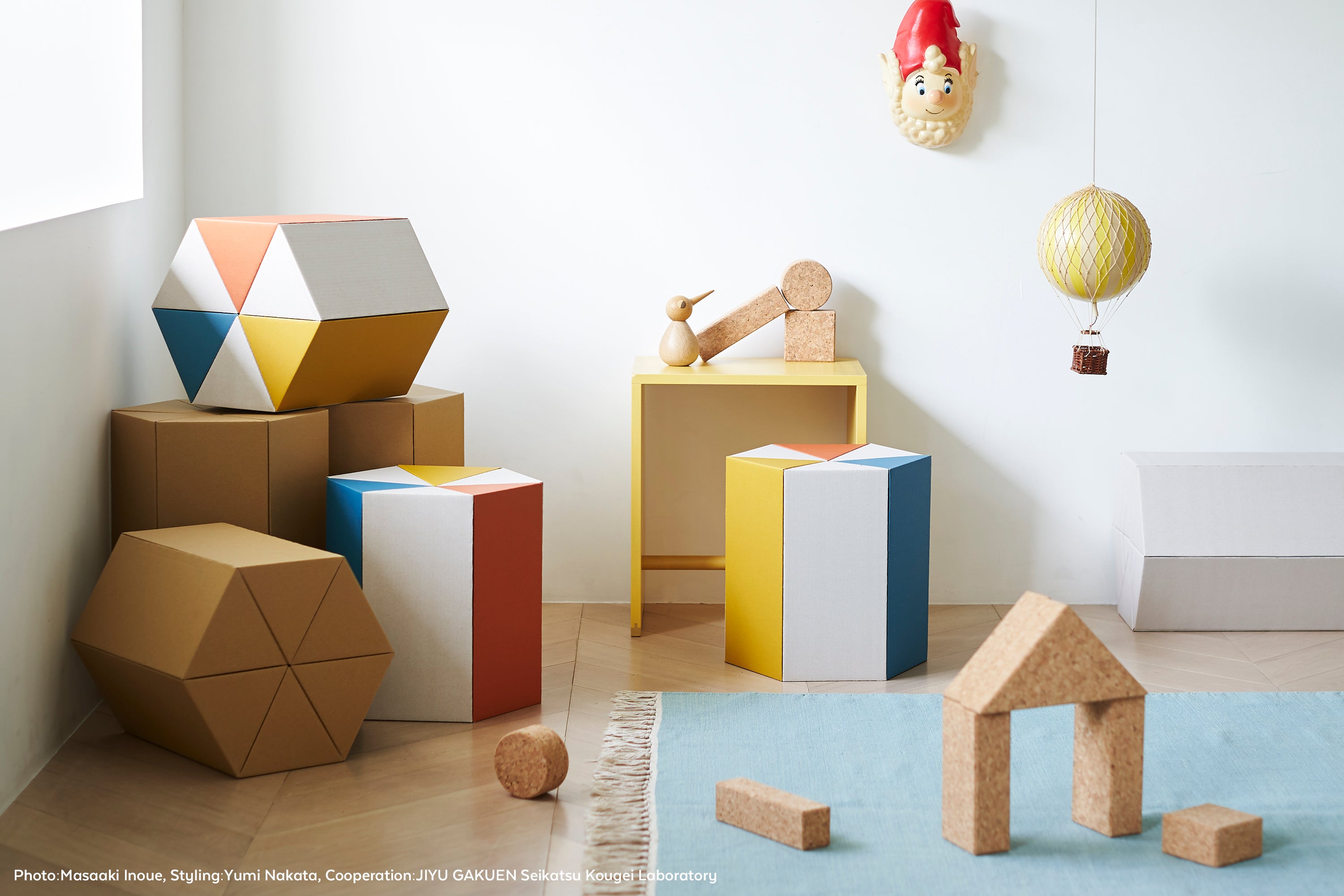
In 1956, the Trii Stool and Round Table received the Gold Medal at the 11th Milan Triennale. In 1967, Watanabe won the 13th Mainichi Industrial Design Award for his cardboard furniture series, including the Riki Stool, as well as the tabletop electric clock Castron 601. The Pole Clock, designed in 1972 and installed beside the Hibiya Dai-Ichi Life Insurance Building, also became a widely recognized landmark.
Through these works, the studio made a significant contribution to the development of interior and product design in Japan. Following Riki Watanabe’s retirement in 2000, Q Designers was naturally dissolved.